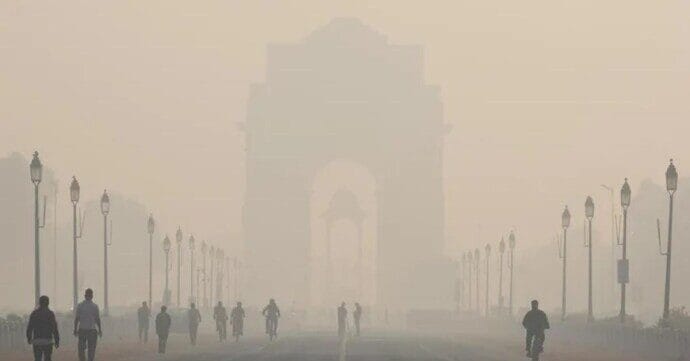
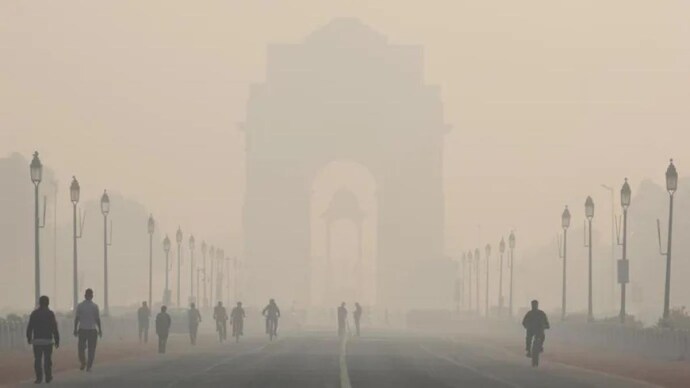
Delhi woke up to a thick layer of toxic haze for the second consecutive day after Diwali, with air quality remaining in the ‘very poor’ category, according to the Central Pollution Control Board (CPCB).
At 7 am, the city’s overall Air Quality Index (AQI) stood at 345, while several monitoring stations recorded readings above 400, indicating ‘severe’ air pollution levels.
Despite a significant fall in stubble-burning incidents, the spike in particulate matter was largely attributed to Diwali firecracker violations and unfavorable weather conditions that trapped pollutants close to the ground.
🌫️ 34 of 38 Stations Record ‘Red Zone’ Air
Out of 38 CPCB monitoring stations, 34 were in the ‘red zone’, representing ‘very poor’ to ‘severe’ air quality.
Two major sites — Punjabi Bagh (AQI 433) and Wazirpur (AQI 401) — fell in the ‘severe’ category, while others such as ITO (361), Anand Vihar (385), and RK Puram (348) also reported extremely high particulate concentrations.
Officials said PM2.5 levels averaged 488 µg/m³, nearly 100 times the WHO’s safe limit of 5 µg/m³, posing serious health risks, especially to children and the elderly.
“The calm wind conditions after Diwali night prevented dispersion of pollutants, worsening the air quality despite fewer stubble-burning incidents this year,” said a senior CPCB scientist.
💥 Firecracker Ban Violations Despite Supreme Court Order
The Supreme Court had allowed the use of ‘green firecrackers’ in Delhi-NCR for only two hours — from 8 pm to 10 pm on Diwali day — but enforcement remained weak.
Residents in several parts of the capital reportedly burst fireworks well past midnight, flouting restrictions and contributing to the pollution spike.
“Continuous violations of the Supreme Court’s time limit and restrictions on conventional firecrackers have undone much of the gains from reduced crop burning,” said an official from the Delhi Pollution Control Committee (DPCC).
🧾 Delhi AQI: How Bad Is It?
| AQI Range | Category | Health Impact |
|---|---|---|
| 0–50 | Good | Minimal impact |
| 51–100 | Satisfactory | Minor discomfort |
| 101–200 | Moderate | Irritation in sensitive groups |
| 201–300 | Poor | Breathing discomfort on prolonged exposure |
| 301–400 | Very Poor | Respiratory illness likely |
| 401–500 | Severe | Health emergency situation |
📉 Despite Drop in Stubble Burning, Air Still Hazardous
CPCB data shows that stubble-burning incidents in Punjab and Haryana have dropped by nearly 77.5% this season compared to last year.
However, low wind speed, temperature inversion, and firecracker smoke combined to create a dense smog layer across Delhi-NCR.
“Even with fewer farm fires, the local emissions — mainly from vehicles and fireworks — are enough to push Delhi into the ‘very poor’ zone when weather conditions are unfavorable,” an IMD meteorologist said.
🏛️ Political Blame Game Over Delhi Smog
The capital’s worsening air has triggered fresh political sparring between the Aam Aadmi Party (AAP) and the Bharatiya Janata Party (BJP).
AAP leaders accused the BJP-led municipal authorities of “failing to enforce pollution control norms,” while BJP leaders blamed the Delhi government’s “inaction on local sources of pollution.”
AAP MLA Gopal Rai alleged that “BJP leaders encouraged people to burst firecrackers,” while state party chief Saurabh Bharadwaj mocked the Delhi government’s response, claiming the leadership “doesn’t even understand AQI.”
🩺 Health Experts Warn Against Outdoor Exposure
Doctors have advised residents — especially children, the elderly, and those with respiratory conditions — to avoid outdoor exercise, use N95 masks, and keep air purifiers running indoors.
Hospitals in Delhi have also reported a rise in asthma and bronchitis cases post-Diwali, particularly among people exposed to late-night smoke and fireworks.
📊 At a Glance: Delhi Air Quality (October 22, 2025)
| Parameter | Value / Status |
|---|---|
| Overall AQI | 345 – Very Poor |
| PM2.5 Average | 488 µg/m³ |
| Stations in Red Zone | 34 of 38 |
| Severe Stations | Punjabi Bagh (433), Wazirpur (401) |
| Stubble Burning Change | ↓ 77.5% from 2024 |
| Supreme Court Window | 8 pm – 10 pm (violated) |