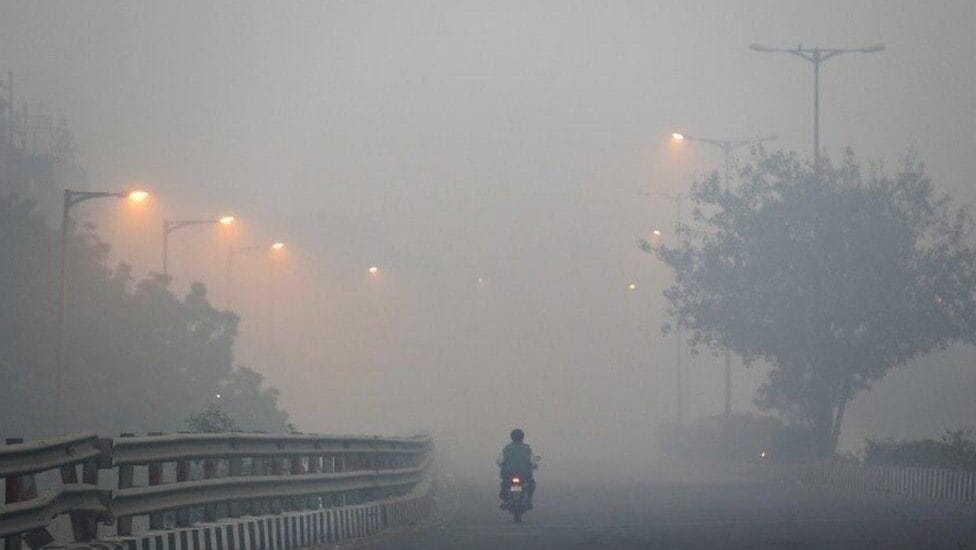
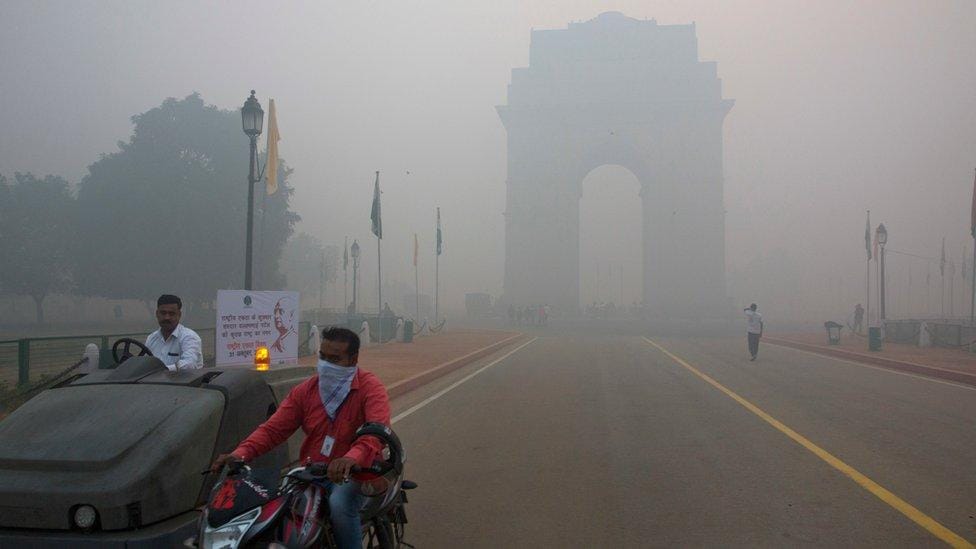
A thick blanket of smog engulfed Delhi on Tuesday morning, as pollution levels spiked sharply after Diwali fireworks across the National Capital Region (NCR) on Monday night.
According to the Central Pollution Control Board (CPCB), 34 out of 37 monitoring stations in the city recorded ‘very poor’ to ‘severe’ air quality, pushing the capital into the ‘red zone’ less than 12 hours after the festival.
At 6:05 a.m., Delhi’s overall Air Quality Index (AQI) stood at 347, classified as “very poor.” The city’s 24-hour average AQI, reported at 4 p.m. Monday, was 345, nearly unchanged from Diwali night.
🌫️ Delhi AQI Live: What the Numbers Show
According to the CPCB’s SAMEER app, at least three key stations recorded AQI above 400, entering the ‘severe’ category:
- Bawana: 418
- Wazirpur: 408
- Jahangirpuri: 404
Meanwhile, only three locations recorded AQI below 300, staying within the ‘poor’ range:
- Sri Aurobindo Marg: 209
- Delhi Technological University (DTU): 242
- IGI Airport (T3): 294
Visuals shared by PTI showed dense smog reducing visibility across major roads such as Ring Road, NH-48, and Rajpath, with headlights and street lamps glowing dimly through the haze.
“Visibility dropped to below 800 metres in several parts of central and west Delhi early Tuesday,”
an IMD official said.
📉 Pollution Likely to Worsen
Meteorologists and air-quality experts warn that the capital’s pollution levels could further deteriorate into the ‘severe’ category by late Tuesday and Wednesday, as calm winds and low temperature inversion prevent dispersal of pollutants.
Neighbouring cities recorded similar air quality:
- Noida: AQI 324 (Very Poor)
- Ghaziabad: AQI 326 (Very Poor)
- Gurugram: AQI 317 (Very Poor)
“The concentration of PM2.5 and PM10 is likely to rise overnight, given stagnant wind patterns,”
said a senior scientist at CPCB.
⚙️ Delhi-NCR Under GRAP Stage II
The Commission for Air Quality Management (CAQM) has enforced Stage II of the Graded Response Action Plan (GRAP) across Delhi-NCR since Sunday evening.
Stage II measures include:
- Ban on diesel generator use (except for essential services)
- Higher parking fees to discourage private vehicle use
- Restriction on non-BS VI diesel vehicles entering Delhi
- Increased mechanical road sweeping and water sprinkling in pollution hotspots
Officials said Stage III curbs — which include bans on construction and demolition — could be imposed if conditions worsen in the next 48 hours.
🔊 Firecrackers and Supreme Court Guidelines
Despite restrictions, large-scale firecracker bursting was reported across the capital on Diwali night.
The Supreme Court, in its October 15 order, had allowed limited use of “green firecrackers” in Delhi-NCR during specific time windows — 6 a.m. to 7 p.m. and 8 p.m. to 10 p.m. — on Diwali eve and Diwali day.
However, widespread violations were noted across outer Delhi and East NCR districts, contributing to a post-festival pollution spike.
“While green crackers emit less particulate matter, large-scale use negates the benefits,”
said a Delhi Pollution Control Committee (DPCC) official.
🌍 Delhi’s Air Quality Category Explained
| AQI Range | Category | Impact on Health |
|---|---|---|
| 0–50 | Good | Minimal impact |
| 51–100 | Satisfactory | Minor discomfort for sensitive groups |
| 101–200 | Moderate | Breathing discomfort for asthma patients |
| 201–300 | Poor | Fatigue, throat irritation possible |
| 301–400 | Very Poor | Respiratory distress on prolonged exposure |
| 401–500 | Severe | Serious health effects for all |
📅 Outlook: Rising Smog, Falling Visibility
The India Meteorological Department (IMD) said wind speeds are expected to remain below 6 km/h, with high humidity and low mixing height, which could trap pollutants near the surface until Wednesday.
“No significant improvement in air quality is expected for at least 48 hours,”
an IMD official said.
The CAQM has called an emergency review meeting with Delhi, Haryana, and UP pollution control boards later today to assess the situation and decide on next-stage curbs.