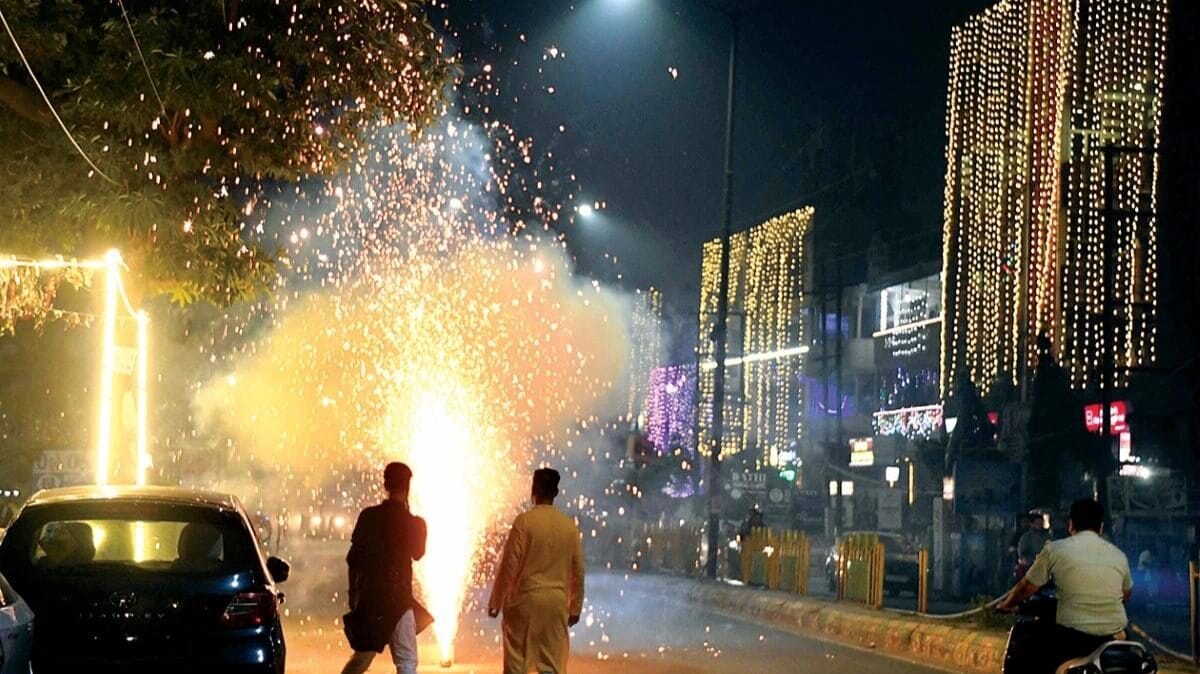
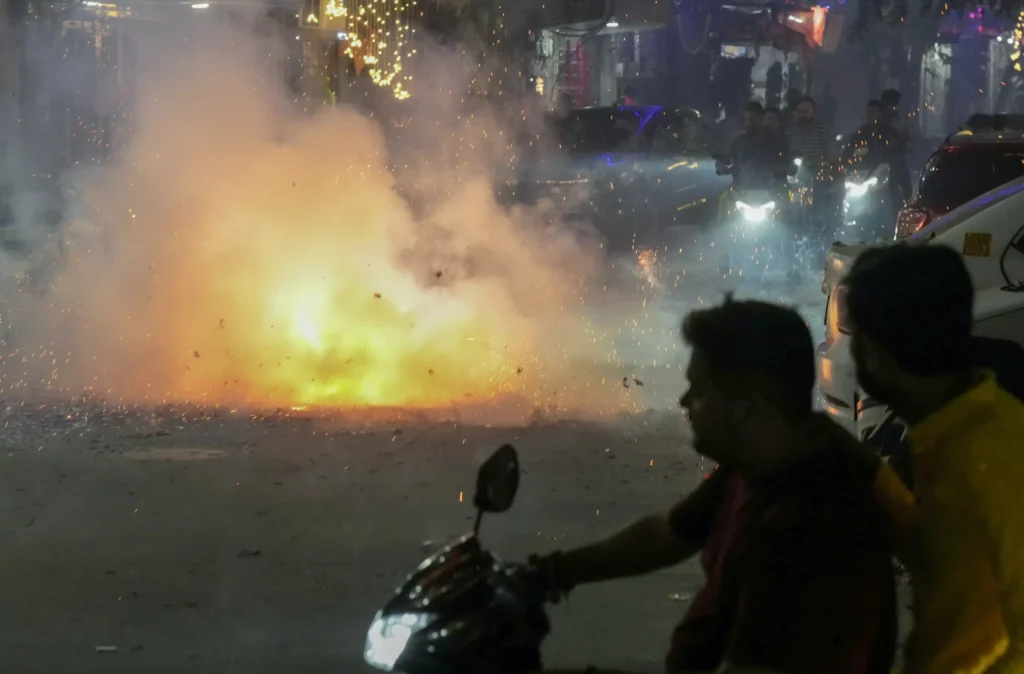
Delhi celebrated a cracker-filled Diwali on Monday even as its air quality index (AQI) sank into the “very poor” category, with most areas recording pollution levels in the red zone by evening, officials said.
According to the Central Pollution Control Board (CPCB), the city’s overall AQI at 6 p.m. stood at 345, while several monitoring stations reported readings above 400, indicating “severe” air quality.
“Out of 38 monitoring stations, 34 recorded AQI in the ‘very poor’ to ‘severe’ range,”
a CPCB official said, adding that pollution levels were expected to worsen overnight due to continued cracker use and stagnant weather conditions.
🌫️ Toxic Air Returns Despite Green Crackers
While authorities permitted only green firecrackers this year under Supreme Court guidelines, violations were reported across multiple districts of the capital, including Anand Vihar, Wazirpur, Jahangirpuri, and RK Puram.
The Commission for Air Quality Management (CAQM) said that firecracker emissions, combined with low wind speed and temperature inversion, led to a sharp evening spike in pollution levels.
“Even limited bursting of green crackers under controlled hours contributed to PM2.5 accumulation,”
said an official from the Delhi Pollution Control Committee (DPCC).
📉 AQI Levels Across Key Locations
| Location | 6 a.m. AQI | 10 a.m. AQI | Category |
|---|---|---|---|
| Anand Vihar | 414 | 411 | Severe |
| Wazirpur | 398 | 419 | Severe |
| RK Puram | 365 | 372 | Very Poor |
| ITO | 331 | 349 | Very Poor |
| Sri Aurobindo Marg | 158 | 168 | Moderate |
By nightfall, most areas saw pollution readings climb again, with visibility dropping below 1,200 metres in several parts of Delhi.
⚠️ Stage II of GRAP Enforced Across Delhi-NCR
Delhi-NCR is currently operating under Stage II of the Graded Response Action Plan (GRAP), activated Sunday evening to curb pollution ahead of Diwali.
Stage II measures include:
- Strict enforcement against diesel generator use (except for essential services)
- Higher parking fees to discourage private vehicle use
- Ban on non-BS VI diesel buses and trucks from entering Delhi
- Intensified mechanical road sweeping and water sprinkling in hotspots
The CAQM said it would review conditions daily and impose Stage III curbs — including restrictions on construction and demolition — if pollution levels continue to rise.
🔊 Supreme Court’s Conditional Approval for Green Crackers
Earlier this month, the Supreme Court permitted the sale and bursting of green firecrackers in Delhi-NCR under strict conditions.
Their use was allowed between 6 a.m. to 7 p.m. and 8 p.m. to 10 p.m. on the day before and the day of Diwali.
Environmental groups, however, said enforcement gaps and poor public awareness led to violations in several localities.
“We saw widespread cracker use past midnight in parts of North and West Delhi,”
said a researcher from Centre for Science and Environment (CSE).
“The spike pattern is identical to pre-ban levels.”
🌍 Delhi Braces for Post-Diwali Smog
Meteorologists warned that calm winds and low temperatures over the next 48 hours could trap pollutants near the surface, worsening smog conditions on Tuesday and Wednesday.
The India Meteorological Department (IMD) said air quality may deteriorate further into the “severe” category by Tuesday morning.
Neighbouring cities like Gurugram, Noida, and Ghaziabad also reported AQI levels above 320.
🧾 Delhi’s AQI Trend (October 10–14)
| Date | AQI (Average) | Category |
|---|---|---|
| Oct 10 | 248 | Poor |
| Oct 11 | 298 | Poor |
| Oct 12 | 312 | Very Poor |
| Oct 13 (Pre-Diwali) | 335 | Very Poor |
| Oct 14 (Diwali) | 345 | Very Poor / Severe |
🏛️ Officials Appeal for Caution
Delhi Environment Minister Gopal Rai urged residents to avoid further firecracker use and cooperate with GRAP measures.
“The festival has ended, but the real challenge starts now.
Citizens must help by using public transport and avoiding open burning,” Rai said.
The CAQM has directed agencies to submit compliance reports on cracker violations and construction dust within 48 hours.